Lambda — Descent and Ascent System
This entry documents a controlled simulation of a modular descent and ascent system designed for lunar and planetary surface operations. The objective is to evaluate trajectory stability, velocity behavior, and structural consistency across a simplified mission profile, without external correction inputs.
Descent Profile
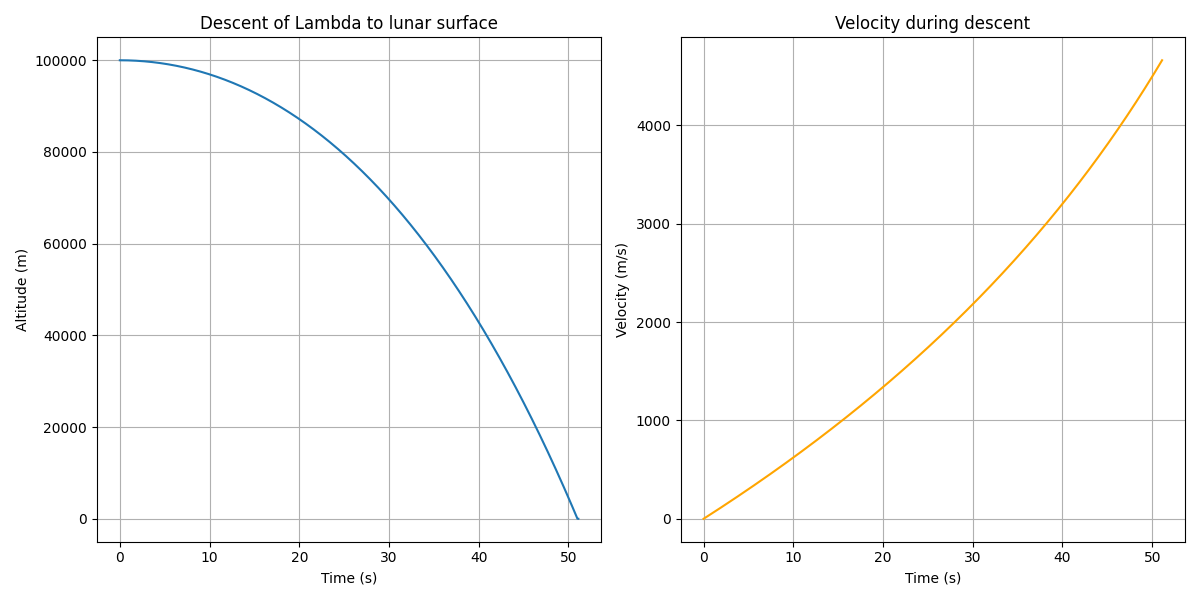
The descent phase models a continuous gravitational approach from orbital altitude to surface contact. The trajectory follows a non-linear decay, with velocity increasing progressively under simulated gravitational influence. The system maintains a predictable descent curve, with no abrupt instability or discontinuity in altitude progression.
Ascent Profile
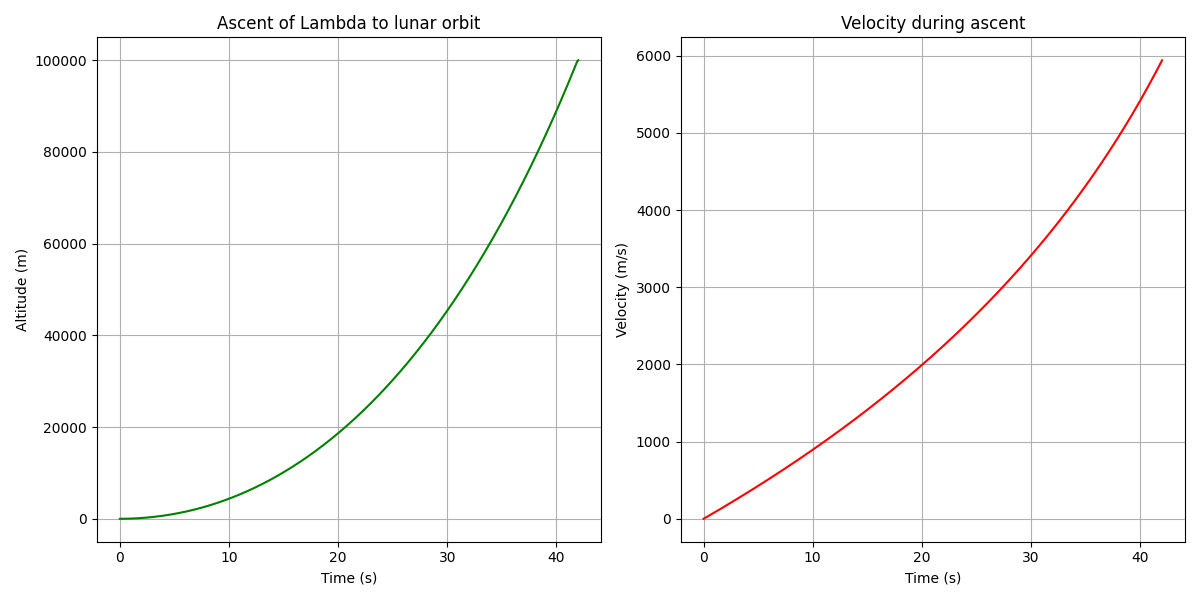
The ascent phase evaluates the system's ability to regain orbital altitude through a continuous thrust-driven trajectory. The altitude curve demonstrates consistent acceleration, while the velocity profile indicates controlled energy transfer throughout the ascent window. No oscillation or trajectory fragmentation is observed during this phase.
System Notes
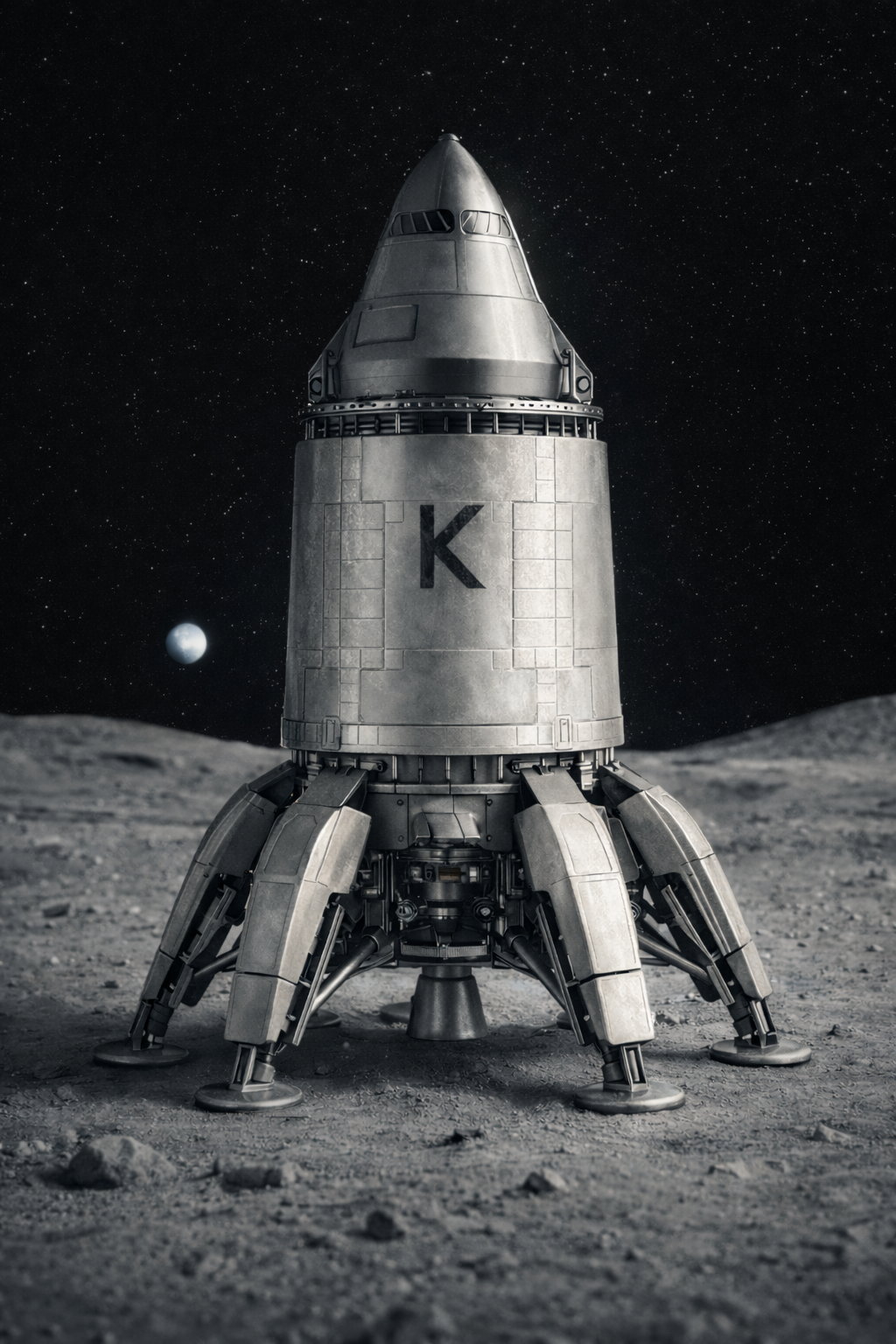
The Lambda system is structured as a modular vehicle composed of stacked cylindrical segments and integrated propulsion. The simulation assumes a closed operational environment, focusing on internal consistency rather than external perturbation modeling.
- Total mass: 10,000 kg
- Total height: 16.04 m
- Engine thrust: 150 kN
- Specific impulse: 510 s
- Delta-v capacity: 5800 m/s
Preliminary Observation
Under the simulated conditions, the system maintains a continuous and stable trajectory across both descent and ascent phases. The absence of discontinuities in both altitude and velocity profiles suggests internal coherence within the modeled parameters. These results represent an early-stage validation and should not be interpreted as a fully qualified flight model.
Visual Reference
The following render represents a conceptual configuration of the Lambda system based on the structural assumptions used in the simulation. This image is provided as a visual reference and does not represent a finalized engineering model.